

Chain Reaction Grid


- Rating:
- 6 (5 votes)
- Engine:
- HTML5 / JavaScript
- Platform:
- Browser (Desktop and Mobile)
- Orientation:
- Landscape and Portrait
- Release date:
- August 14, 2026
- Last update:
- August 14, 2026
Chain Reaction Grid Game Description
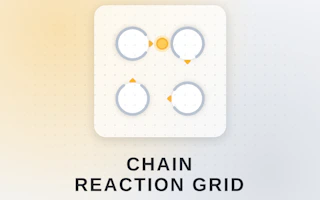
Chain Reaction Grid is a compact cascade puzzle. Every tile carries a number and an arrow. Tap one to fire it, and a pulse travels along that arrow until it meets another tile — which loses one, and fires in turn. At zero a tile shatters, and it still fires on its way out.
Empty ground is skipped, so the board keeps re-routing as tiles vanish: the same arrow reaches further at the end of a board than it did at the start. Reading that ahead is the whole game.
Read the board, then click
Clicking a tile never damages it — something else has to. A pulse stops at the first tile in its path, so every tile that shatters opens a lane the next pulse travels much further down. The board you finish is not the board you started on, and playing for that is the whole game.
Where a chain stops
An arrow pointing off the edge is where a cascade dies, and roughly how many of them there are is how many clicks a board needs. Count them before spending a charge. Undo is free, and a board wrecked beyond saving is called straight away rather than clicked out to the end.
How to play Chain Reaction Grid?
Desktop
Click a tile = Fire it
Mobile
Tap a tile = Fire it
Both
Undo = Take back one charge
Reset = Back to the full board
Hint = Point out a tile to fire
New puzzle = Fresh board
Hint
Firing sends a pulse along that tile's arrow. The first tile the pulse meets loses one and fires in turn; at zero a tile shatters, and it still fires on the way out. Pulses skip empty ground, so the board re-routes as it empties. Clear every tile before the charges run out.
Platform
Browser Desktop , Mobile and Tablet
Release date
August 14, 2026
Last update
August 14, 2026
FAQs
Why did clicking a tile not lower its number?
Firing costs a charge, not a point. A tile only loses a number when another tile's pulse reaches it, which is the constraint the puzzle is built on.
What happens when the charges run out?
The board is lost. Reset replays the same board, or take a new one. Charges are the shortest solution plus a small margin.